
Navigating the world of kitchen measurements can sometimes feel like solving a complex puzzle, especially when you’re in the middle of preparing a delicious meal or scaling a beloved recipe. Questions like, “How many cups in a quart?” or “How many pints are in a gallon?” frequently arise, challenging even experienced home cooks. Understanding these fundamental kitchen conversions is crucial for culinary success, ensuring your dishes turn out perfectly every time. This comprehensive guide is designed to demystify common kitchen conversions, providing clear explanations, practical tips, and handy reference charts to empower your cooking and baking adventures.
Whether you’re doubling a family-favorite casserole, halving a dessert recipe, or simply trying to understand the difference between U.S. liquid measurements and their metric equivalents, having a reliable resource at your fingertips is invaluable. We’ll explore the relationships between cups, pints, quarts, and gallons, along with other essential measurements like teaspoons, tablespoons, and fluid ounces. By the end of this article, you’ll have a solid grasp of these conversions, making you a more confident and efficient cook.
Click HERE for a free printable kitchen conversion chart.
Table of Contents
- The Importance of Accurate Kitchen Conversions
- Understanding the U.S. Customary Liquid Measurement System
- How Many Cups in a Quart?
- How Many Cups in a Pint?
- How Many Pints in a Quart?
- How Many Quarts in a Gallon?
- How Many Cups in a Gallon?
- Comprehensive Kitchen Measurement Guide
- Teaspoons and Tablespoons: Essential Small Measurements
- Wet Ingredient Conversions for Liquids
- Dry Ingredient Conversions for Solids
- Measuring Liquid Ingredients vs. Dry Ingredients: Why It Matters
- Tips for Precise Measurements in the Kitchen
- Conclusion
- More Helpful Kitchen Measurements and Charts
The Importance of Accurate Kitchen Conversions
Precision is key in cooking, and it becomes absolutely critical in baking. A recipe is essentially a scientific formula, and even slight deviations in ingredient measurements can drastically alter the outcome. Imagine baking a cake where you accidentally add too much flour or too little liquid – the texture could become dense and dry, or crumbly and fall apart. Conversely, getting your measurements just right ensures consistent results, allowing you to recreate your favorite dishes flawlessly every time.
Kitchen conversions are not just about precision; they also offer flexibility. They allow you to adapt recipes to fit your needs, whether you’re feeding a large gathering or cooking for one. You might find a fantastic recipe that serves eight, but you only need to feed four. Knowing how to correctly halve all the ingredient amounts, from gallons to teaspoons, is essential. Similarly, if you want to double a recipe for a party, converting measurements accurately ensures the flavors and textures remain balanced. These skills also become indispensable when substituting ingredients or dealing with recipes that use slightly different measurement units, perhaps from an older cookbook or an international source.
Understanding the U.S. Customary Liquid Measurement System
The charts and conversions provided here primarily adhere to the U.S. customary system of liquid measurements, which is widely used in American kitchens. This system, while different from the metric system (liters, milliliters) used by most of the world, has its own logical structure. Here’s a quick overview of the main liquid units and their relationships, offering a glance at the bigger picture before we delve into specifics:
- 1 Gallon (gal) = 4 Quarts = 8 Pints = 16 Cups = 128 Fluid Ounces ≈ 3.785 Liters
- 1 Quart (qt) = 2 Pints = 4 Cups = 32 Fluid Ounces ≈ 0.946 Liters
- 1 Pint (pt) = 2 Cups = 16 Fluid Ounces ≈ 0.473 Liters
- 1 Cup (c) = 8 Fluid Ounces = 48 Teaspoons = 16 Tablespoons ≈ 0.236 Liters
These foundational conversions are the building blocks for adjusting any recipe. Familiarizing yourself with these relationships will make kitchen calculations intuitive and effortless.
How Many Cups in a Quart?
One of the most frequently asked questions in the kitchen is, “How many cups are in a quart?” The answer is straightforward and easy to remember: there are 4 cups in a quart. This conversion is incredibly common, especially when working with recipes that call for larger quantities of liquids like broth, milk, or water. For example, if a recipe requires 2 quarts of chicken stock, you’ll know you need 8 cups (2 quarts * 4 cups/quart = 8 cups). This simple relationship forms a cornerstone of liquid measurement conversions.
4 cups = 1 quart
How Many Cups in a Pint?
Moving down the scale, the next common conversion involves pints. Many recipes, especially those for beverages or smaller batches, might call for ingredients in pints. So, how many cups are in a pint? There are 2 cups in a pint. This makes converting from pints to cups, or vice versa, quite simple. If you have a pint of heavy cream and a recipe asks for cups, you’re looking at 2 cups. This conversion is particularly useful when you have ingredients packaged in pint containers, such as sour cream, berries, or ice cream, and need to measure them in smaller cup increments.
2 cups = 1 pint
How Many Pints in a Quart?
Understanding the relationship between pints and quarts is another key conversion. Just as there are 2 cups in a pint, there are 2 pints in a quart. This means a quart is double the volume of a pint. Think of it this way: if you fill two pint-sized containers with liquid, combined they would perfectly fill a quart-sized container. This knowledge helps immensely when scaling recipes or when you only have measuring tools for one unit but the recipe calls for another.
2 pints = 1 quart
How Many Quarts in a Gallon?
Gallons represent the largest common liquid measurement unit in the U.S. customary system, often used for bulk liquids like milk, juice, or large quantities of water. Knowing how many quarts make up a gallon is essential for large-scale cooking or shopping. The conversion is: there are 4 quarts in a gallon. This is why you often see milk sold in gallon jugs or half-gallon cartons (which contain 2 quarts). This conversion is very practical for understanding packaging sizes and for catering to bigger events.
4 quarts = 1 gallon
How Many Cups in a Gallon?
Now, let’s combine our knowledge to answer a comprehensive question: how many cups are in a gallon? Since we know there are 4 quarts in a gallon, and 4 cups in each quart, we can multiply these figures: 4 quarts/gallon * 4 cups/quart = 16 cups/gallon. Therefore, there are 16 cups in a gallon. This is a significant volume, often encountered when preparing large batches of iced tea, lemonade, or soup for a crowd. This overarching conversion helps you conceptualize the entire U.S. liquid measurement system from the smallest common unit to the largest.
16 cups = 1 gallon
Click HERE for a free printable kitchen conversion chart.
Comprehensive Kitchen Measurement Guide
Beyond the primary cup-pint-quart-gallon conversions, a myriad of other measurements come into play during cooking and baking. From tiny dashes to larger portions, knowing these conversions allows for seamless recipe execution and adaptation. Here’s a more detailed breakdown to help you master your kitchen measurements. Remember to print out the convenient charts provided above to keep a quick reference in your cooking space!
- How Many Cups In A Quart: 4 Cups
- How Many Pints In A Quart: 2 Pints
- How Many Quarts In A Gallon: 4 Quarts
- How Many Cups In A Pint: 2 Cups
- How Many Pints In A Gallon: 8 Pints (since 1 gallon = 4 quarts, and 1 quart = 2 pints, then 4 quarts * 2 pints/quart = 8 pints)
- How Many Cups In A Half Gallon: 8 Cups (since a half gallon is 2 quarts, and 1 quart = 4 cups, then 2 quarts * 4 cups/quart = 8 cups)
- How Many Cups In A Gallon: 16 Cups
Teaspoons and Tablespoons: Essential Small Measurements
When dealing with spices, extracts, leavening agents like baking powder, or small amounts of liquids, teaspoons and tablespoons are your go-to measuring tools. Precision here is paramount, as even a small error can significantly impact the flavor or structure of your dish. Understanding their relationship to each other and to cups is fundamental.
- How Many Teaspoons In A Tablespoon: 3 Teaspoons. This is a very common conversion, often encountered when a recipe calls for tablespoons but you only have teaspoons, or vice-versa.
- How Many Tablespoons In 1/8 Cup: 2 Tablespoons. This helps bridge the gap between small and larger measurements.
- How Many Tablespoons In 1/4 Cup: 4 Tablespoons.
- How Many Tablespoons In 1/2 Cup: 8 Tablespoons.
- How Many Tablespoons In 1 Cup: 16 Tablespoons. This completes the conversion from the smallest common unit (teaspoon) up to a full cup.
Wet Ingredient Conversions for Liquids
Liquid measurements primarily deal with fluid ounces, which are distinct from ounces used for weighing dry ingredients. This section focuses on the relationships between ounces, tablespoons, cups, pints, quarts, and gallons, specifically for liquid ingredients such as water, milk, oil, and extracts.
- 1/2 Fluid Ounce = 1 Tablespoon. This is a handy conversion for small liquid additions.
- 2 Fluid Ounces = 1/4 Cup.
- 8 Fluid Ounces = 1 Cup. This is a very important and frequently used conversion for liquids.
- 16 Fluid Ounces = 1 Pint. This shows the direct relationship between fluid ounces and pints.
- 1 Pint = 2 Cups.
- 1 Quart = 2 Pints.
- 1 Gallon = 4 Quarts.
Dry Ingredient Conversions for Solids
Dry ingredient conversions encompass a range of units from tiny pinches and dashes to cups. These are typically used for flour, sugar, spices, herbs, and other solid components. While some units like ‘dash’ or ‘pinch’ are less precise, they are traditional and often appear in older recipes or for minor seasoning adjustments.
- 1 Dash = Approximately 1/16 Teaspoon. A dash is a very small, indefinite amount, usually applied quickly.
- 1 Pinch = Approximately 1/8 Teaspoon. Slightly more than a dash, a pinch is also an imprecise measure, literally what you can hold between your thumb and forefinger.
- 3 Teaspoons = 1 Tablespoon.
- 1/8 Cup = 2 Tablespoons.
- 1/3 Cup = 5 Tablespoons + 1 Teaspoon. This is one of the more specific and less intuitive conversions, very helpful for precision.
- 3/4 Cup = 12 Tablespoons.
- 1 Cup = 16 Tablespoons.
Measuring Liquid Ingredients vs. Dry Ingredients: Why It Matters
When it comes to the art and science of cooking, and particularly baking, ensuring accurate ingredient measurements is absolutely paramount for a delicious outcome. A critical distinction often overlooked by novice cooks is the difference in how you measure liquid ingredients versus dry ingredients, and why specific tools are designed for each.
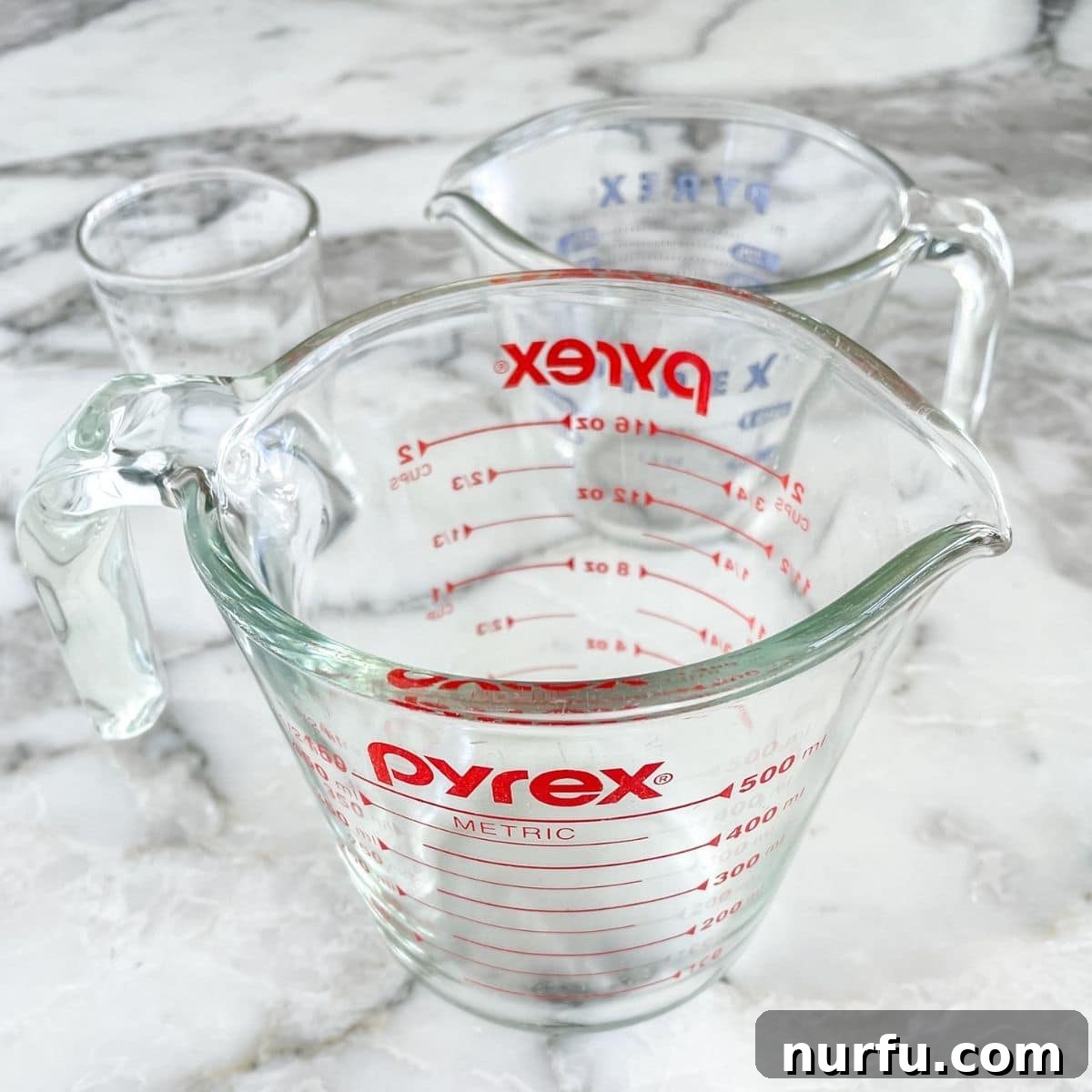
Liquid measuring cups are typically made of clear glass or plastic and feature a spout for easy pouring. They also have extra space above the highest measurement mark, preventing spills when filling and transporting. The measurement lines are usually marked on the side, and you should always check the measurement at eye level to account for the meniscus (the curved surface of the liquid). Common liquids measured this way include water, milk, oils, broths, and extracts. Using a dry measuring cup for liquids can lead to overfilling and inaccurate readings due to the lack of a spout and the difficulty of viewing the liquid level precisely.
Conversely, dry measuring cups and spoons are designed for precise measurement of solid or granular ingredients. They come in sets (e.g., 1 cup, 1/2 cup, 1/3 cup, 1/4 cup) and have flat tops. To measure accurately, you should overfill the cup or spoon slightly, then use a straight edge (like the back of a knife or a flat spatula) to level off the excess, ensuring a perfectly flat surface. This method is crucial for ingredients like flour, granulated sugar, brown sugar (which often needs to be packed), oats, and spices. Using a liquid measuring cup for dry ingredients would make it impossible to level accurately, leading to inconsistent amounts. For flour, specifically, it’s often recommended to “spoon and level” – spoon the flour into the measuring cup rather than scooping directly from the bag, which can compact the flour and result in too much being added.
Understanding and applying these distinct measuring techniques is vital. Mis-measuring can lead to significant changes in the texture, consistency, and overall success of your culinary creations. For instance, too much flour can make baked goods dry and dense, while too little can make them fall flat. By using the correct tools and techniques, you ensure your dishes consistently achieve their intended perfection.
Tips for Precise Measurements in the Kitchen
Achieving accuracy in the kitchen goes beyond simply knowing the conversion rates; it also involves employing proper measuring techniques. Here are some invaluable tips to ensure your measurements are always spot-on:
- Eye Level for Liquids: When measuring liquids, always place your liquid measuring cup on a flat surface and bend down to check the measurement at eye level. This prevents parallax error, where the reading appears different depending on your viewing angle, ensuring you accurately read the bottom of the meniscus.
- Leveling Dry Ingredients: For dry ingredients like flour, sugar, or cocoa powder, spoon the ingredient into the dry measuring cup until it overflows slightly. Then, use a straight edge (such as the back of a knife or a straight spatula) to sweep across the top of the cup, removing any excess for a perfectly level measurement. Avoid shaking or tapping the cup, as this can compact the ingredient.
- Packing Brown Sugar: Unlike other dry ingredients, brown sugar needs to be packed firmly into the measuring cup. It should hold the shape of the cup when inverted. This ensures you get the correct amount of sugar, as its moist texture allows for compression.
- Spoon and Level for Flour: For flour, specifically, it’s often recommended to lightly spoon the flour into the measuring cup rather than scooping directly from the bag. Scooping can compact the flour, leading to significantly more flour than intended. Once spooned in, level it off with a straight edge.
- Use the Right Tools: Always use dedicated liquid measuring cups for liquids and dry measuring cups/spoons for dry ingredients. As discussed, they are designed for different properties and measuring techniques.
- Zero Your Scale for Weight: For ultimate precision, especially in baking, a digital kitchen scale is invaluable. Always tare (zero out) your scale with the empty container on it before adding ingredients. This ensures you’re measuring only the ingredient itself.
By incorporating these simple yet effective techniques into your cooking routine, you’ll elevate your kitchen accuracy, minimize errors, and consistently achieve delicious results.
Conclusion
Mastering kitchen conversions and understanding proper measuring techniques are fundamental skills for any home cook or baker. Whether you’re a beginner or an experienced chef, having a clear grasp of “how many cups in a quart,” “how many pints in a gallon,” and all the other relationships between our common measurement units will undoubtedly boost your confidence and proficiency in the kitchen. We hope this comprehensive guide has successfully answered all your kitchen conversion questions, providing you with the tools and knowledge to tackle any recipe with ease.
Remember to keep those printable charts handy in your kitchen for quick reference, and don’t hesitate to consult them whenever a conversion question arises. For those who enjoy digital tools, you can also try this easy online conversion calculator.
Happy cooking, and may your measurements always be accurate!
More Helpful Kitchen Measurements and Charts
Expand your kitchen knowledge even further with these additional resources:
- Stick of butter conversion: Essential for baking, learn how to easily convert butter measurements.
- How many ounces in a cup?: Another crucial conversion for liquid and dry ingredients – includes a free printable!
- How many teaspoons in a tablespoon: A quick dive into these small but mighty measurements.
- Air fryer cooking chart: Beyond conversions, explore cooking times for your favorite air fryer recipes.