
In the culinary world, precision is paramount. Whether you’re a seasoned chef, an enthusiastic home cook, or a passionate baker eager to try a new recipe, achieving the correct oven temperature is a fundamental step towards guaranteed success. Ovens, much like ingredients, speak different languages depending on where you are in the world. This often leads to confusion when recipes specify temperatures in units unfamiliar to your kitchen. That’s why having a reliable oven temperature conversion guide is indispensable.
We’ve meticulously designed this comprehensive oven temperature conversion chart and guide to help you seamlessly navigate between the most common oven temperature units: Fahrenheit (°F), Celsius (°C), and the traditional Gas Marks. Understanding and accurately converting these measurements will unlock a world of international recipes and ensure your dishes turn out perfectly every time.
This conversion chart is more than just a table; it’s an essential companion designed to empower you in the kitchen, enabling you to follow recipes from any corner of the globe. In the United States, Fahrenheit is the standard measurement for oven temperatures, while a significant portion of the rest of the world utilizes Celsius. Similarly, many traditional British recipes still rely on Gas Marks. Without a proper conversion tool, the simple act of baking a batch of delicious cookies or perfectly roasted pork tenderloin could become a frustrating guessing game, potentially leading to undercooked or overbaked results. Our user-friendly guide removes this barrier, ensuring your culinary adventures are always a triumph.
Your Essential Oven Temperature Conversion Chart
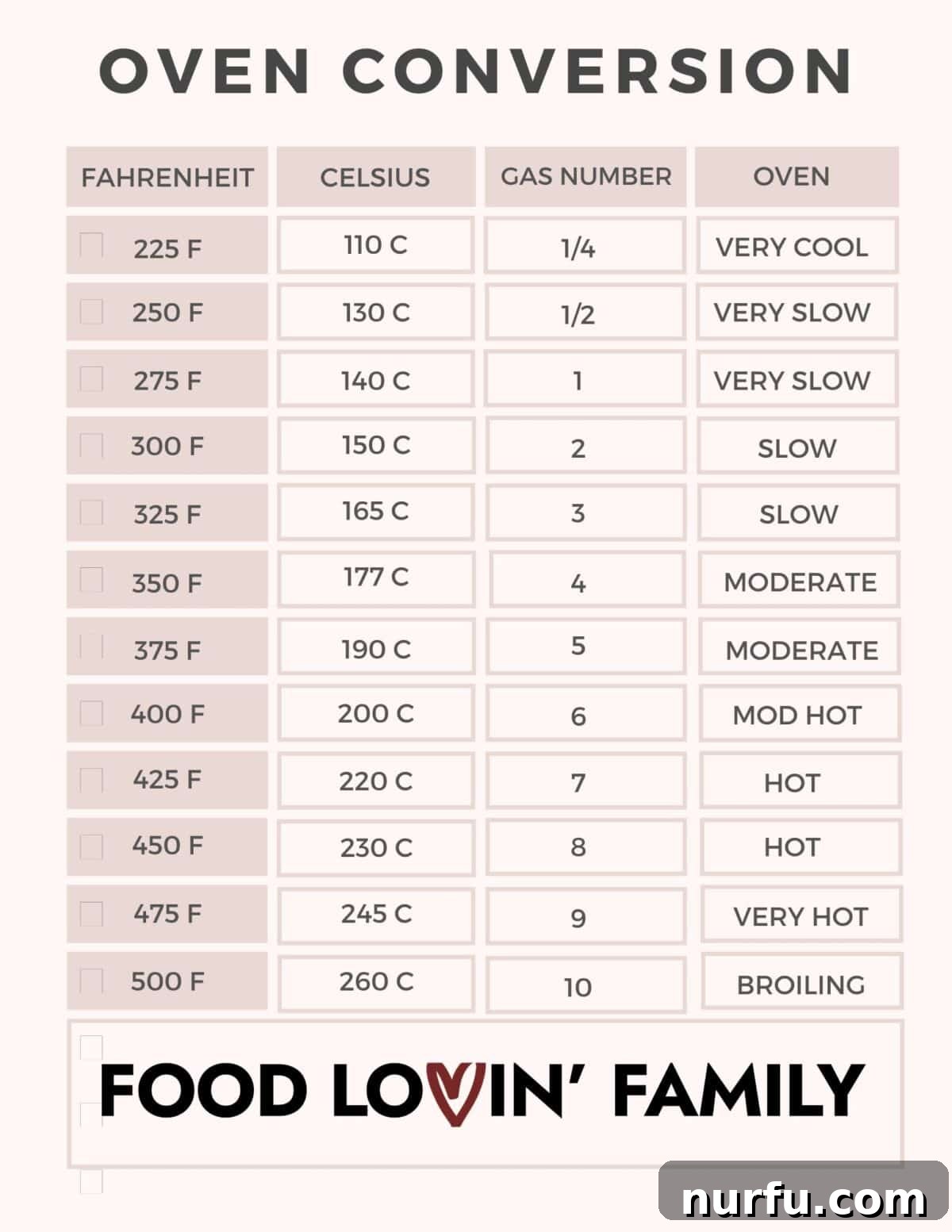
Below you will find a detailed conversion chart, providing approximate equivalences between Fahrenheit, Celsius, and Gas Marks. While these conversions are excellent for quick reference, remember that individual ovens can vary, and an oven thermometer is always recommended for ultimate precision. For those times when the chart doesn’t quite match your needs, keep scrolling to discover the exact mathematical equations for precise conversions.
| Fahrenheit °F | Celsius °C | Gas Number | Oven Description |
| 225 °F | 110 °C | 1/4 | Very Cool / Very Low |
| 250 °F | 130 °C | 1/2 | Very Cool / Very Low |
| 275 °F | 140 °C | 1 | Slow / Low |
| 300 °F | 150 °C | 2 | Slow / Low |
| 325 °F | 165 °C | 3 | Slow / Moderate-Low |
| 350 °F | 177 °C | 4 | Moderate |
| 375 °F | 190 °C | 5 | Moderate |
| 400 °F | 200 °C | 6 | Moderately Hot / Hot |
| 425 °F | 220 °C | 7 | Hot |
| 450 °F | 230 °C | 8 | Hot / Very Hot |
| 475 °F | 245 °C | 9 | Very Hot |
| 500 °F | 260 °C | 10 | Broiling / Extremely Hot |
Why Accurate Oven Temperatures Are Crucial for Culinary Success
Achieving the right oven temperature isn’t just about following a recipe; it’s about understanding the science behind cooking. Small deviations can have significant impacts on the final texture, flavor, and appearance of your dishes. Here’s why precision is so important:
- Baking Perfection: For delicate items like cakes, soufflés, and pastries, even a 25-degree difference can be disastrous. Too cool an oven, and your cake might sink in the middle, or cookies might spread too much. Too hot, and the exterior could burn before the interior is cooked through, leading to dense, dry results. Proper temperature ensures even leavening, perfect browning (thanks to the Maillard reaction), and the desired crumb structure.
- Roasting Excellence: When roasting meats or vegetables, consistent heat is key to tender interiors and beautifully caramelized exteriors. An oven that’s too cool will dry out your roast, while one that’s too hot can burn the outside quickly, leaving the inside raw. Accurate temperatures also play a vital role in reaching safe internal cooking temperatures for poultry and pork, preventing foodborne illnesses.
- Consistent Results: If you want to replicate a dish successfully every time, you need to eliminate variables. Oven temperature is one of the biggest. Knowing your oven is correctly calibrated and setting it to the precise temperature specified in the recipe ensures reliability and builds your confidence in the kitchen.
Keep Conversions Handy: Your Printable Oven Temperature Chart
To make your cooking experience even smoother, we’ve created a convenient printable version of our oven temperature conversion chart. This allows you to keep these essential conversions right where you need them most – in your kitchen, taped inside a cabinet door, or laminated for durability. No more fumbling with phones or wet recipe books; simply glance at your printable chart and continue cooking with confidence.
Download
How to Convert Fahrenheit to Celsius: The Mathematical Formula
While our chart provides quick look-ups, understanding the underlying formula allows you to convert any Fahrenheit temperature to Celsius, even those not listed. This knowledge is particularly useful for obscure recipe temperatures or when working with older ovens that might not precisely align with standard increments.
The formula to convert Fahrenheit to Celsius is straightforward:
C = (F – 32) × 0.5556 (or 5/9)
Let’s walk through an example using 375 °F:
- Start with the Fahrenheit temperature: 375 °F
- Subtract 32 from this value: 375 – 32 = 343
- Multiply the result by 0.5556: 343 × 0.5556 = 190.5708
- Round to the nearest whole number for practical oven use: 191 °C (or 190 °C as a close approximation, which aligns with our chart).
So, 375 °F is approximately 191 °C.
How to Convert Celsius to Fahrenheit: The Reverse Calculation
Equally important is the ability to convert Celsius to Fahrenheit, especially when cooking from international cookbooks or websites. This formula will ensure you can confidently tackle any recipe, regardless of its origin.
The formula to convert Celsius to Fahrenheit is:
F = (C × 1.8) + 32 (or C × 9/5 + 32)
Let’s use an example of 200 °C:
- Start with the Celsius temperature: 200 °C
- Multiply this value by 1.8: 200 × 1.8 = 360
- Add 32 to the result: 360 + 32 = 392
- For practical oven use, this can be rounded to the nearest standard increment, such as 400 °F, which aligns with our conversion chart.
Therefore, 200 °C is precisely 392 °F, often rounded to 400 °F for oven settings.
Understanding Gas Mark Conversions
Gas Mark is a temperature scale primarily used in the United Kingdom and Ireland, particularly with gas ovens. Unlike Fahrenheit and Celsius, which are linear, Gas Marks increase in non-linear increments. This means that the difference in temperature between Gas Mark 1 and Gas Mark 2 isn’t the same as the difference between Gas Mark 8 and Gas Mark 9.
The Gas Mark scale starts at Gas Mark 1/4 (very cool) and goes up to Gas Mark 9 or 10 (very hot/broiling). Because of its non-linear nature, direct mathematical conversion formulas are less commonly used; instead, charts like ours provide the best and most practical way to convert. If you encounter a Gas Mark not on the chart, it’s often best to consult an online calculator or extrapolate based on the nearest values, keeping in mind the non-linear progression.
What is the Fundamental Difference Between Fahrenheit and Celsius?
Fahrenheit and Celsius are both scales for measuring temperature, but they are based on different reference points, primarily the freezing and boiling points of water. This difference in reference points leads to their distinct numerical values for the same temperature.
- Celsius (°C): This scale, part of the metric system, is used by most countries worldwide. It establishes 0°C as the freezing point of water and 100°C as the boiling point of water at standard atmospheric pressure. The range between freezing and boiling is divided into 100 equal degrees, making it a very intuitive scale for scientific applications and everyday use in metric regions.
- Fahrenheit (°F): Predominantly used in the United States, its territories, and a few Caribbean nations, the Fahrenheit scale sets the freezing point of water at 32°F and the boiling point at 212°F. This means there are 180 degrees between the freezing and boiling points of water. Its origin is somewhat more complex, historically tied to specific brine solutions and human body temperature.
Understanding these fundamental differences helps clarify why conversions are necessary and why a temperature of 20°C feels vastly different from 20°F.
Tips for Ensuring Oven Temperature Accuracy
Even with the perfect conversion chart, your cooking can still be compromised if your oven isn’t accurately calibrated. Here are some essential tips to ensure your oven is performing optimally:
- Invest in an Oven Thermometer: The dial on your oven can often be inaccurate by as much as 25-50 degrees. An inexpensive, freestanding oven thermometer placed inside your oven will give you the true temperature, allowing you to adjust your oven dial accordingly. This is perhaps the single most important tool for temperature accuracy.
- Preheat Properly: Always allow your oven to fully preheat. Most ovens signal they’ve reached the set temperature sooner than they actually have. Give it an extra 10-15 minutes after the preheat light comes on to ensure the entire oven cavity, including the walls and racks, has reached the desired temperature.
- Avoid Frequent Door Opening: Each time you open the oven door, the temperature can drop significantly – sometimes by 50-100 degrees Fahrenheit. This prolongs cooking times and can negatively impact delicate baked goods. Use your oven light to check on food whenever possible.
- Understand Hot Spots: Most ovens have hot spots. Rotating your dishes halfway through cooking can help ensure more even baking or roasting. An oven thermometer can also help identify these zones if you test different areas.
- Clean Your Oven Regularly: Built-up grease and food residue can affect your oven’s efficiency and temperature regulation. A clean oven operates more effectively.
Conclusion: Mastering Oven Temperature for Culinary Confidence
Mastering oven temperature conversion and accuracy is a game-changer for any cook. It opens up a world of recipes, eliminates frustrating guesswork, and consistently leads to more delicious results. By utilizing our comprehensive conversion chart, understanding the mathematical formulas, and implementing best practices for oven accuracy, you are well on your way to becoming a more confident and successful chef. Don’t let a simple temperature unit stand between you and your next culinary masterpiece. Happy cooking!
Expand Your Kitchen Knowledge with More Essential Measurements
Understanding conversions isn’t limited to oven temperatures. Many other kitchen measurements can be tricky. Broaden your culinary expertise with our other helpful guides:
- How Many Cups in a Quart?
- How Many Ounces in a Cup?
- How Many Teaspoons in a Tablespoon?
- How Many Ounces in a Pound?
- How Many ML in a Shot?
- How Many Grams in a Pound?