
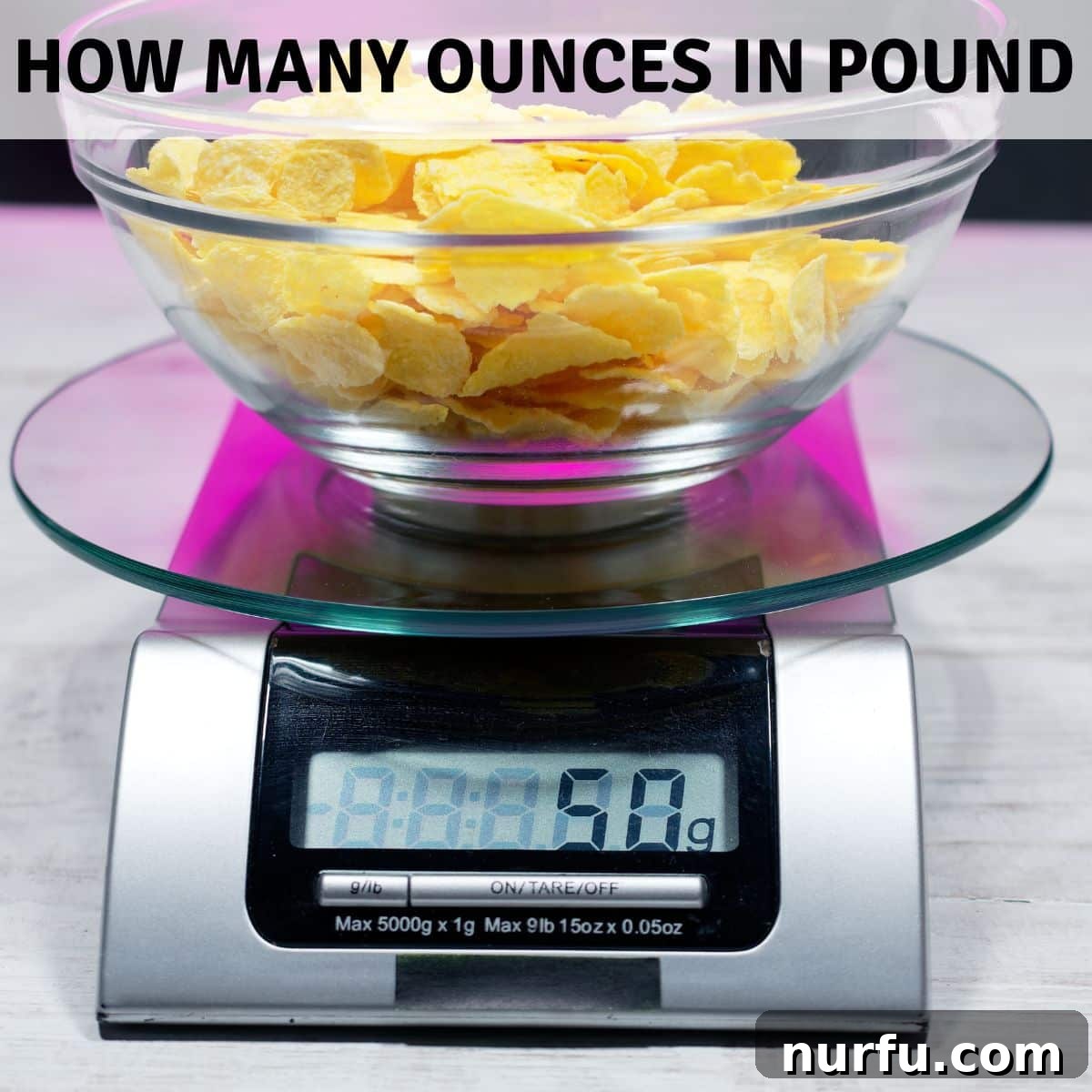
Navigating the kitchen can often feel like a culinary adventure, and sometimes, that adventure requires a bit of mathematical insight. One of the most fundamental and frequently asked questions for home cooks and bakers alike is: “How many ounces in a pound?” Understanding this simple conversion is key to achieving perfect results, whether you’re baking a delicate cake or preparing a hearty family meal.
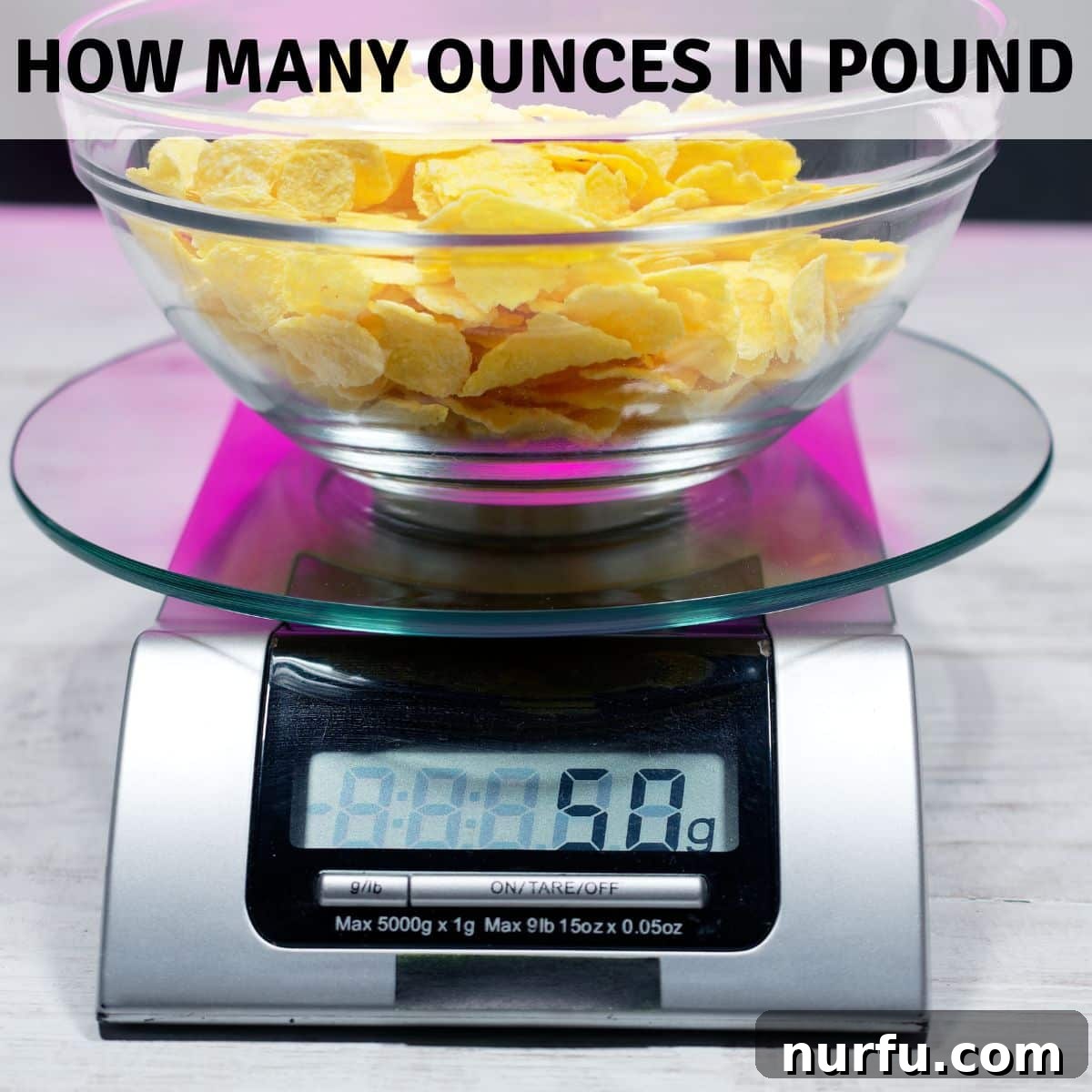
How Many Ounces In A Pound: The Essential Conversion
Let’s get straight to the heart of the matter. The most crucial conversion to remember when dealing with everyday weight measurements in the United States Customary System (USCS) is:
1 pound (lb) = 16 ounces (oz)
This relationship is based on the avoirdupois system, which is the standard for most commercial and general-purpose weighing in countries like the U.S. and historically, the British Empire. This consistent ratio of 16 ounces to 1 pound makes converting between these units straightforward once you know the rule.
Pounds To Ounces Conversion Table
To help visualize and quickly reference common conversions, here’s an expanded table:
- 0.5 pounds = 8 ounces
- 1 pound = 16 ounces
- 1.5 pounds = 24 ounces
- 2 pounds = 32 ounces
- 2.5 pounds = 40 ounces
- 3 pounds = 48 ounces
- 4 pounds = 64 ounces
- 5 pounds = 80 ounces
- 6 pounds = 96 ounces
- 7 pounds = 112 ounces
- 8 pounds = 128 ounces
- 9 pounds = 144 ounces
- 10 pounds = 160 ounces
- 15 pounds = 240 ounces
- 20 pounds = 320 ounces
These conversions are specifically for dry weight measurements. The distinction between dry weight and fluid volume is vital, and we’ll delve deeper into that shortly.
Understanding the Units: What is an Ounce?
The term “ounce” can sometimes cause confusion due to its dual nature as both a unit of weight (mass) and a unit of volume (fluid ounce). Historically, the ounce derives from the Roman uncia, meaning “twelfth part,” though its value has varied significantly over time and across different systems.
The Avoirdupois Ounce (Weight)
When we talk about “ounces” in the context of “how many ounces in a pound,” we are almost always referring to the avoirdupois ounce. This system became prevalent in the British Isles during the Middle Ages for weighing general merchandise. One avoirdupois ounce is precisely 1/16th of an avoirdupois pound and is approximately equal to 28.35 grams. This is the ounce you use when weighing ingredients like flour, sugar, meat, or vegetables on a kitchen scale.
The Troy Ounce (Weight)
Less commonly encountered in the kitchen but good to know for context, the troy ounce is a different unit of weight primarily used for measuring precious metals like gold, silver, and platinum. A troy ounce is slightly heavier than an avoirdupois ounce (approximately 31.103 grams) and there are 12 troy ounces in a troy pound. Rest assured, you won’t be using troy ounces for your recipes!
The Fluid Ounce (Volume)
This is where things can get tricky. A fluid ounce (fl oz) is a unit of volume, not weight. It measures how much space a liquid occupies. In the US Customary System, 1 cup equals 8 fluid ounces. The critical thing to remember is that while 1 fluid ounce of water weighs approximately 1 avoirdupois ounce, this is not true for other ingredients due to differences in density. For example, 1 fluid ounce of honey will weigh more than 1 fluid ounce of water, and 1 fluid ounce of flour will weigh significantly less.
Understanding the Units: What is a Pound?
The pound, like the ounce, has a rich and complex history. Its name comes from the Latin word pondo, meaning “by weight,” and its symbol “lb” is an abbreviation of the Roman term libra pondo (“a pound by weight”).
The Avoirdupois Pound
The avoirdupois pound, standardized internationally, is the unit of weight we use in everyday life and cooking. It is precisely defined as 0.45359237 kilograms. This system was developed to efficiently weigh heavier goods and remains the standard for measuring body weight, groceries, and many other items in the United States.
Other Pounds
Just as with ounces, there have been other types of pounds historically, such as the troy pound (12 troy ounces) and the apothecaries’ pound (also 12 ounces, used in pharmacy). However, for culinary purposes, the avoirdupois pound is the one and only pound you need to be concerned with.
Mastering the Conversion: Pounds to Ounces (and Vice Versa)
Converting between pounds and ounces is a simple arithmetic task once you understand the core relationship:
To convert pounds to ounces: Multiply the number of pounds by 16.
Example: If a recipe calls for 1.75 pounds of chicken, how many ounces is that?
1.75 pounds * 16 ounces/pound = 28 ounces
To convert ounces to pounds: Divide the number of ounces by 16.
Example: If you have 56 ounces of ground beef, how many pounds do you have?
56 ounces / 16 ounces/pound = 3.5 pounds
These formulas are incredibly useful when scaling recipes, portioning ingredients, or simply understanding product labels at the grocery store.
The Critical Distinction: Dry Weight Ounces vs. Fluid Ounces
This is arguably the most important concept to grasp to avoid common measuring mistakes in the kitchen. As discussed, an “ounce” can refer to both a unit of weight (mass) and a unit of volume. Ignoring this distinction can lead to significant discrepancies in your recipes, especially in baking where precision is paramount.
- Dry Weight Ounces: These measure the actual mass of an ingredient. When a recipe asks for “10 ounces of flour” or “1 pound of sugar,” it is referring to dry weight. You must use a kitchen scale to measure these accurately.
- Fluid Ounces: These measure the volume of a liquid ingredient. When a recipe calls for “8 fluid ounces of milk” or “1 cup of water,” it is referring to fluid ounces. These are measured with liquid measuring cups, which have a spout for easy pouring and markings read at eye level.
Remember: 1 cup is always 8 fluid ounces. However, 1 cup of flour does NOT weigh 8 dry ounces. Due to flour’s lower density, 1 cup of all-purpose flour typically weighs around 4 to 4.5 dry ounces. This difference is why bakers strongly advocate for measuring dry ingredients by weight using a scale rather than by volume using cups, for consistent and professional results.
Beyond Pounds and Ounces: Other Essential Kitchen Conversions
While pounds and ounces are fundamental, several other conversions frequently pop up in recipes. Understanding these helps you navigate any recipe with confidence.
How Many Cups In A Pound
This conversion is the ultimate example of why density matters and why a scale is often superior to a measuring cup for dry ingredients. There is no single answer for “how many cups in a pound” because it depends entirely on the ingredient being measured. A pound of feathers takes up much more space (more cups) than a pound of lead (fewer cups).
- 1 pound of butter = 2 cups (This is a common exception where volume and weight are consistent, as butter is quite dense and standardized.)
- 1 pound of all-purpose flour ≈ 3.5 to 4 cups (depending on how it’s sifted/packed)
- 1 pound of granulated sugar ≈ 2 cups
- 1 pound of brown sugar (packed) ≈ 2.25 cups
- 1 pound of powdered sugar (sifted) ≈ 4 cups
For critical baking recipes, always prioritize weight measurements (pounds or ounces) for dry ingredients to ensure accuracy. If a recipe provides both, default to the weight. For liquids, volume (cups, fluid ounces) is usually acceptable.
If you’re looking for conversions involving liquid volumes, a printable conversion chart can be incredibly helpful for knowing how many cups are in a quart, pint, and gallon.
How Many Tablespoons In An Ounce (Fluid)
For smaller liquid measurements, the conversion between tablespoons and fluid ounces is straightforward:
2 tablespoons = 1 fluid ounce
This is useful for precise measurements of liquids like vanilla extract, oils, or small amounts of sauces. Remember, this applies to fluid ounces, not dry weight ounces.
Essential Measuring Tips for Culinary Success
Accurate measurement is the cornerstone of great cooking and baking. Here are some indispensable tips to ensure your dishes turn out perfectly every time:
- Invest in a Digital Kitchen Scale: This is by far the most crucial tip for precision, especially in baking. Digital scales provide exact measurements in grams, ounces, and sometimes pounds, eliminating the guesswork that comes with volume measurements for dry ingredients. They are an affordable tool that will dramatically improve your results.
- Always Read the Recipe Twice: Before you even start, familiarize yourself with the recipe. Pay close attention to the units specified – is it “ounces” (implying weight for dry goods) or “fluid ounces” (for liquids)?
- Level Dry Ingredients Properly: When using measuring cups or spoons for dry ingredients like flour or sugar (if you must use volume), spoon the ingredient into the cup/spoon and then use the back of a straight knife or a flat edge to level it off. Do not scoop directly from the bag or pack it down unless the recipe specifically calls for “packed” (like brown sugar).
- Measure Liquids at Eye Level: For fluid measuring cups, place the cup on a flat surface and bend down to read the measurement at eye level. This prevents parallax error, where the liquid level appears different depending on your viewing angle.
- Consider Ingredient Density: Always be aware that different ingredients have different densities. A cup of sugar weighs more than a cup of flour, and a cup of oil weighs less than a cup of water. This is why weight measurements are superior for consistency, particularly for solid ingredients.
- Use Proper Measuring Tools: Have a complete set of dry measuring cups, liquid measuring cups, and measuring spoons. They are designed for different tasks and using the right tool makes a difference.
Bridging the Gap: US Customary vs. The Metric System
While ounces and pounds are firmly entrenched in the US Customary System, it’s worth noting that the vast majority of the world uses the metric system, where weight is measured in grams and kilograms, and volume in milliliters and liters. The metric system is lauded for its simplicity and decimal-based conversions (e.g., 1000 grams = 1 kilogram, 1000 milliliters = 1 liter).
When encountering international recipes, you might need to convert between USCS and metric units. For instance, knowing how many grams are in a pound (approximately 453.59 grams) or how many milliliters are in a fluid ounce (approximately 29.57 mL) can be incredibly useful. Many digital scales offer both imperial and metric unit options, making these conversions seamless.
Further Your Kitchen Knowledge with More Basic Conversions
The journey to becoming a confident cook involves understanding many such fundamental conversions. Here are a few more resources to expand your culinary measurement mastery:
- Stick of butter conversion
- How much yeast in a packet
- How many teaspoons in a tablespoon
- How many mL in a shot
Conclusion
Understanding the simple conversion of 1 pound = 16 ounces is more than just memorizing a number; it’s unlocking a deeper understanding of how ingredients interact in your recipes. By grasping the difference between dry weight ounces and fluid ounces, investing in a good kitchen scale, and practicing precise measuring techniques, you empower yourself to achieve consistent, delicious results every time you step into the kitchen. Happy cooking and baking!